Ownership affects your room to act
Control of data, software and working rules affects whether a company can change a service, check a result or act without a provider’s help.
Synthesis of the four scenario worldsToday’s legal institutions, new experiments and emerging alternatives can exist side by side. Choices about training, technology and access can strengthen existing practices or help different ones develop.
This guide draws on a 2026 workshop series exploring four possible futures for law in 2040. Use them to test choices about people, technology and providers. A way to consider three kinds of change together: the legal practices people rely on, experiments that could change them, and alternatives worth developing. They can coexist rather than arrive in a fixed sequence. connects what to preserve, what to test and what to develop at the same time.
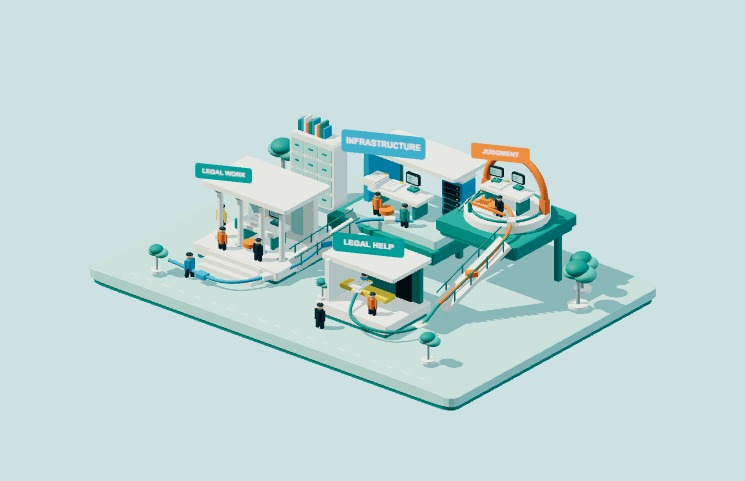
These futures describe different conditions a legal team or business could face. Compare them to test a decision: what should you retain, which providers can you rely on, and where must people be able to intervene?

The company embeds legal checks in everyday business tools. It gains direct control and responsibility for decisions made through them.
Step into this future ↗
The company’s legal team coordinates outside firms and tools while retaining its data. Keeping those services working together becomes a continuing responsibility.
Step into this future ↗
Outside firms and technology companies supply the systems that handle legal work. The company gains capability while depending on providers’ systems and knowledge.
Step into this future ↗
People are meant to review, challenge and stop automated decisions. Whether they have the information and authority to do so remains contested.
Step into this future ↗The workshops began from corporate legal’s perspective. Their questions reach anyone building, buying, delivering or relying on legal help.
Control of data, software and working rules affects whether a company can change a service, check a result or act without a provider’s help.
Synthesis of the four scenario worldsThe fourth scenario questions whether people can meaningfully supervise automated work. Intervention depends on information, expertise and authority to act.
Scenario questions, especially world fourThe consumer and small-business group emphasized affordable help, fair treatment and trust. It also raised the position of people poorly served by existing arrangements.
Recorded consumer-group prioritiesThree Horizons separates work that keeps today’s legal services dependable, experiments that could change them, and longer-term alternatives. All three can be active at once.
Maintain the institutions, expertise and practices that people still need.
Try different tools or services and examine what they improve, and what they leave unresolved.
Develop alternatives that could change how legal work is delivered and who can get help.
Groups considered the same four futures from different positions. Their proposals help identify what an organization might retain, buy, develop or make easier for people to use.
Decide which work, knowledge and decisions the organization needs to retain.
Explore this perspective ↗Change how services are delivered while developing expertise and client relationships.
Explore this perspective ↗Make tools work with customer systems and show useful results.
Explore this perspective ↗Make legal help affordable, fair and open to challenge when something goes wrong.
Explore this perspective ↗